
I’ve spent years breaking down complex warehouse systems into something anyone can understand.
You’re probably here because you keep hearing about AS/RS but nobody’s explaining how these systems actually work. Just a lot of talk about efficiency gains and ROI.
Here’s the reality: traditional warehouses are burning money on wasted space and labor costs. Order accuracy is a constant headache. But understanding how automated storage works etrstech is where most people get stuck.
I’m going to walk you through the actual mechanics. Not the marketing pitch. The real engineering behind how these systems store products, retrieve them, and manage everything in between.
This isn’t about whether you should buy one. It’s about understanding what’s happening inside these systems when they’re running.
You’ll see how the core components fit together, what the software is actually doing, and why these systems can do things human workers simply can’t match.
No fluff about the future of warehousing. Just a clear explanation of how the technology works right now.
What Are Automated Storage and Retrieval Systems (AS/RS)?
Picture a warehouse where robots do all the walking.
That’s basically AS/RS.
Automated Storage and Retrieval Systems are computer-controlled setups that handle your inventory without making humans sprint across football field sized warehouses. The machines store stuff, find stuff, and bring stuff to you.
Simple concept. Big impact.
Here’s the shift that matters.
Old way? You walk to the product. New way? The product comes to you.
We call it moving from person-to-goods to goods-to-person. (Sounds fancy but it just means you stand still while robots do the cardio.)
Your workers aren’t hiking miles every shift. They’re standing at a station while the system delivers exactly what they need. How automated storage works etrstech explains is pretty straightforward when you see it in action.
Now here’s what trips people up.
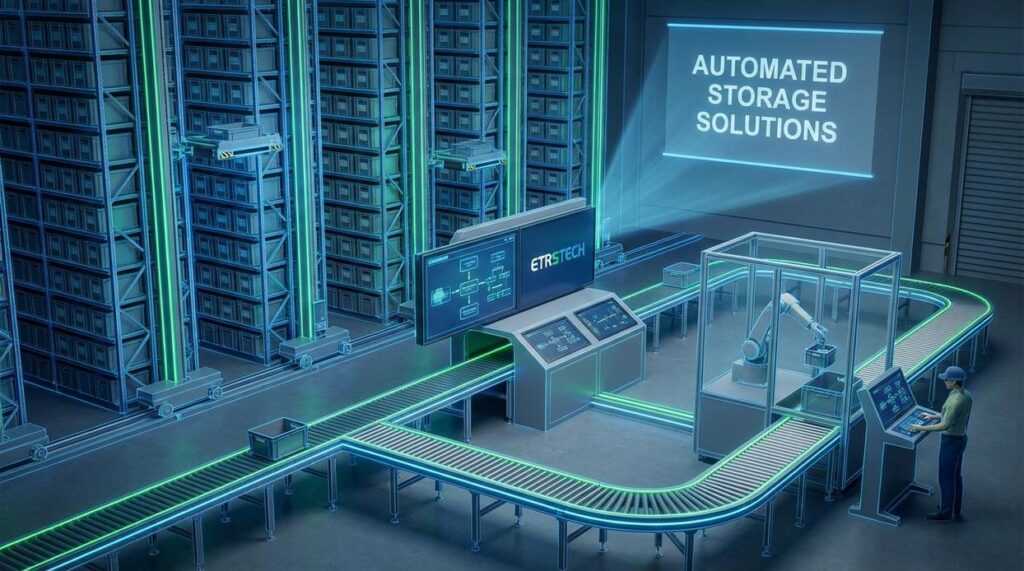
AS/RS isn’t just a robot arm or a fancy conveyor belt. It’s the whole package. You’ve got the storage structure, the machinery that moves around, and the software brain that tells everything where to go.
Think of it like this. The structure is your filing cabinet. The machinery is your hands. The software is your brain remembering where you put everything.
All three work together or the system falls apart.
Most warehouses waste time because someone has to remember where item XYZ-447 lives, walk there, grab it, and walk back. With AS/RS, the computer already knows. The machine already went. Your worker just receives it and keeps moving.
That’s the whole point.
The Core Components: A Functional Breakdown
Let me break down what actually makes an AS/RS system work.
You’ve got three main parts that work together. Think of it like a body where each system has a specific job. In the intricate world of game design, Etrstech serves as the vital connective tissue that allows the narrative, mechanics, and aesthetics to function harmoniously, much like a body where each system has a specific job.
The Skeleton: High-Density Storage Racking
These aren’t your typical warehouse racks.
AS/RS racking goes way taller and packs way tighter than what you’d see in a standard facility. We’re talking structures that can reach 100 feet or more because there’s no need for wide aisles or space for forklifts to maneuver.
The machines don’t need room to turn around. They just need precise pathways to access every storage location.
This is where you get the real space savings. Some warehouses cut their footprint in half just by switching to this kind of setup.
The Muscle: Automated Retrieval Machines
Now here’s where how automated storage works etrstech gets interesting.
You’ve got two main types of machines doing the heavy lifting.
Fixed-aisle cranes stick to one lane. They move up and down, back and forth within that single aisle to grab whatever you need. If you’re storing uniform products in high volumes, this is what I’d recommend. They’re fast and reliable for repetitive tasks.
Roving shuttles and bots are different. These things move independently across multiple levels and aisles. They’re not locked into one path, which means better throughput when you need it. Plus, if one bot goes down, the others keep working (which is a lifesaver during peak seasons).
The Circulatory System: Conveyors and Transfer Stations
Once a machine pulls an item from storage, it needs to get somewhere useful.
That’s where conveyors come in. They move goods from the storage zone to output stations where your team can pack, ship, or send them to manufacturing lines.
The transfer stations act like hubs. They coordinate where each item goes next based on your workflow.
My advice? Don’t cheap out on this part. A bottleneck here kills the speed you gained from automation in the first place.
Common Types of AS/RS and Their Specific Functions

You’ve got options when it comes to automated storage and retrieval systems.
But here’s where people get stuck. They assume all AS/RS systems do the same thing. Just grab stuff and put it back, right?
Wrong.
Each type handles different jobs. And picking the wrong one for your operation? That’s an expensive mistake.
Unit-Load AS/RS handles the heavy lifting. We’re talking pallets and large containers that weigh hundreds or thousands of pounds. These systems work best when you need bulk reserve storage or you’re feeding production lines with raw materials. Think of them as the workhorses of warehouse automation (they’re built for strength, not speed). As the Unit-Load AS/RS efficiently manages the heavy lifting in warehouse automation, integrating advanced solutions like Quantum Encryption Technology Etrstech ensures that sensitive data related to inventory and logistics remains secure throughout the process.
Now compare that to Mini-Load AS/RS.
These systems work with smaller items. Totes, trays, cartons. If you run an e-commerce operation or distribute small parts, this is what you want. They move faster than unit-load systems because they’re handling lighter items. The trade-off? They can’t touch the heavy stuff.
Vertical Lift Modules take a different approach entirely.
Instead of moving horizontally through aisles, VLMs store trays vertically in an enclosed tower. An extractor travels up and down to grab the tray you need and brings it to an ergonomic workstation at waist height. No more climbing ladders or bending down to floor level. If this resonates with you, I dig deeper into it in The Future of 3d Printing Etrstech.
I’ve seen these save serious floor space. You can store thousands of SKUs in the footprint of a small office. Plus, the enclosed design keeps everything secure and dust-free. Perfect for high-value parts or items that need environmental protection.
Horizontal Carousels work on a simpler principle.
Bins rotate on a horizontal track (kind of like a dry cleaner’s rack) to bring items directly to the operator. You’re not walking to the inventory. The inventory comes to you. For small to medium items, this setup can double or triple your picking rates compared to static shelving.
Some people argue that simpler systems like carousels can’t match the sophistication of VLMs or mini-loads. And sure, they don’t have the same density or automation level.
But that’s missing the point.
Carousels cost less upfront and they’re easier to maintain. For operations that don’t need maximum density, they get the job done without the complexity. Understanding how automated storage works etrstech helps you match the right system to your actual needs, not just the fanciest option.
The real question isn’t which system is best. It’s which one fits what you’re actually storing and how fast you need to move it.
The Brains: The Role of Warehouse Control and Management Software
You can have the most advanced hardware in the world. But without smart software running it, you’ve got nothing but expensive metal sitting idle.
Think of it this way. The machines are the muscles. The software is the brain telling them what to do and when to do it.
The Warehouse Control System acts as your traffic cop.
It sends real-time commands to every piece of equipment on the floor. Move this pallet. Retrieve that bin. Stop here. Go there. All in milliseconds.
But that’s just half the picture.
The Warehouse Management System maintains something most facilities dream about: a 100% accurate inventory map that updates constantly. It knows exactly where every single item sits at any given moment.
Here’s where it gets interesting.
When new goods arrive, the WMS doesn’t just tell the AS/RS to stick them anywhere. It thinks about future retrieval. High-demand items? Those go in the most accessible spots. Slow movers get placed further back. (Same reason grocery stores put milk at the back of the store, except this actually helps you.)
How automated storage works etrstech comes down to three key steps:
- The system receives incoming orders from your sales channels
- It batches those orders based on location and priority
- It directs the AS/RS to retrieve items in the most efficient sequence possible
That last part matters more than you’d think.
Instead of sending a machine back and forth across the warehouse like a ping pong ball, the software maps out routes that minimize travel time. Less movement means faster fulfillment and lower energy costs. As the gaming industry continues to evolve with innovative logistics solutions, it becomes increasingly important to analyze Which Trends Affect Igaming Etrstech to ensure optimal efficiency and sustainability in operations.Which Trends Affect Igaming Etrstech
The difference between good software and great software? Great software learns. It spots patterns in your order history and adjusts storage locations before you even ask.
Similar to how quantum encryption technology etrstech processes complex data streams, modern WMS platforms handle millions of data points to keep everything running smooth.
A Symphony of Hardware and Software
I’ve walked you through how automated storage works etrstech from the ground up.
You’ve seen the dense physical storage. The precise robotic machinery. The intelligent software logic that ties it all together.
This isn’t just cool technology for its own sake.
It solves the real problems that have plagued warehouses for decades. Wasted space because you can’t stack high enough. Human error from repetitive tasks. Slow retrieval times that bottleneck your entire operation.
AS/RS works because it takes the most repetitive and physically demanding work off human hands. The result is speed you couldn’t achieve manually, accuracy that eliminates costly mistakes, and storage density that maximizes every square foot.
Now you understand the functionality. That’s your foundation.
Your next step is to look at your own operation. Where are you losing time? Where is space going to waste? Which tasks are creating the most errors?
Match those pain points against what you’ve learned here. That’s how you figure out which type of automation actually fits your needs instead of just chasing the latest trend.
The technology exists. The question is whether you’re ready to use it. Which Trends Affect Igaming Etrstech.
 There is a specific skill involved in explaining something clearly — one that is completely separate from actually knowing the subject. Jexor Veythorne has both. They has spent years working with latest technology news in a hands-on capacity, and an equal amount of time figuring out how to translate that experience into writing that people with different backgrounds can actually absorb and use.
Jexor tends to approach complex subjects — Latest Technology News, Software Development Insights, Emerging Technology Trends being good examples — by starting with what the reader already knows, then building outward from there rather than dropping them in the deep end. It sounds like a small thing. In practice it makes a significant difference in whether someone finishes the article or abandons it halfway through. They is also good at knowing when to stop — a surprisingly underrated skill. Some writers bury useful information under so many caveats and qualifications that the point disappears. Jexor knows where the point is and gets there without too many detours.
The practical effect of all this is that people who read Jexor's work tend to come away actually capable of doing something with it. Not just vaguely informed — actually capable. For a writer working in latest technology news, that is probably the best possible outcome, and it's the standard Jexor holds they's own work to.
There is a specific skill involved in explaining something clearly — one that is completely separate from actually knowing the subject. Jexor Veythorne has both. They has spent years working with latest technology news in a hands-on capacity, and an equal amount of time figuring out how to translate that experience into writing that people with different backgrounds can actually absorb and use.
Jexor tends to approach complex subjects — Latest Technology News, Software Development Insights, Emerging Technology Trends being good examples — by starting with what the reader already knows, then building outward from there rather than dropping them in the deep end. It sounds like a small thing. In practice it makes a significant difference in whether someone finishes the article or abandons it halfway through. They is also good at knowing when to stop — a surprisingly underrated skill. Some writers bury useful information under so many caveats and qualifications that the point disappears. Jexor knows where the point is and gets there without too many detours.
The practical effect of all this is that people who read Jexor's work tend to come away actually capable of doing something with it. Not just vaguely informed — actually capable. For a writer working in latest technology news, that is probably the best possible outcome, and it's the standard Jexor holds they's own work to.